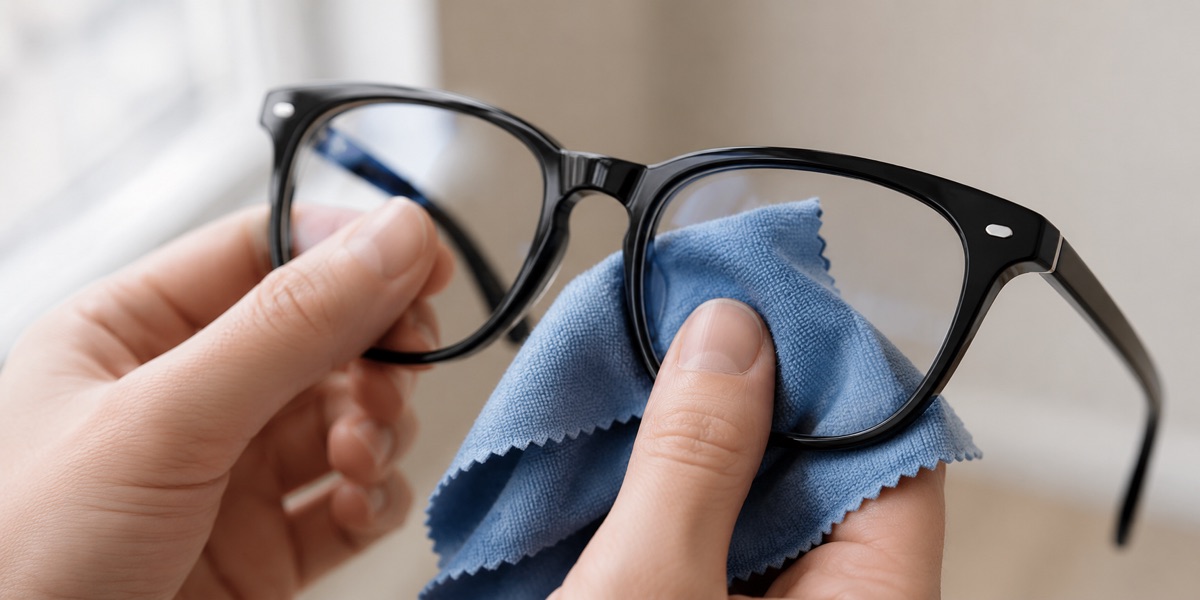
Most people who wear glasses clean them several times a day. Very few do it correctly.
The habits that seem harmless — wiping with a shirt hem, blowing on the lens, using a tissue — are quietly scratching and degrading your lenses over months and years. Since quality lenses are a significant investment, it’s worth knowing what the science says about proper care.
Why Lens Cleaning Matters Beyond Clarity
Modern prescription lenses often carry multiple applied coatings: anti-reflective (AR) coatings, UV filters, blue-light management coatings, and scratch-resistant layers. These coatings are thin, precise, and vulnerable.
A 2012 review published in Contact Lens & Anterior Eye found that improper cleaning is among the leading causes of premature coating degradation — significantly reducing both optical clarity and the effective lifespan of lenses. Scratches also scatter incoming light, increasing glare and visual fatigue.
What Damages Lenses
Dry wiping
The most common mistake. Even soft-seeming fabrics — shirt cotton, tissue paper, paper towels — are abrasive at a microscopic level. Wiping a dry lens pushes dust particles and skin oils across the surface, creating fine circular scratches over time.
Household cleaning products
Window cleaners, hand sanitisers, and all-purpose sprays often contain ammonia, bleach, or acetone. These compounds strip anti-reflective and UV coatings within a few uses. Even mild soap bars can leave residue that degrades coatings.
Breathing on the lens
Breath moisture is slightly acidic and contains proteins from saliva. While a single instance causes minimal harm, habitual use contributes to coating deterioration and leaves organic residue that attracts more dust.
Rough microfibre cloths
Not all microfibre is equal. Cheap cloths become embedded with abrasive particles after repeated use. A microfibre cloth that is not regularly washed is often more harmful than a clean one.
The Correct Method
What you need:
- Lukewarm water (not hot — heat can damage coatings)
- A small drop of plain liquid dish soap (fragrance-free, lotion-free)
- A clean, lens-specific microfibre cloth
The method:
- Rinse both lenses under lukewarm running water. This removes loose dust and particles before you touch the lens — the most important step.
- Apply one small drop of dish soap to each lens.
- Gently rub both surfaces of the lens and the frame with your fingertips — including the nose pads, which accumulate oils and bacteria.
- Rinse thoroughly under lukewarm water until soap is completely gone.
- Shake gently to remove excess water, then carefully blot dry with a clean microfibre cloth. Do not rub — blot.
This method is recommended by the American Academy of Ophthalmology for daily lens care.
Keeping Your Microfibre Cloth Clean
A microfibre cloth used daily without washing will embed skin oils, dust, and environmental particles — and then transfer them back to your lenses. Wash your lens cloth with mild liquid soap, rinse well, and allow to air dry at least once a week. Do not wash it with regular laundry (it picks up lint from other fabrics).
When to Use Lens Wipes
Pre-moistened lens wipes (designed specifically for optics) are a good option when water isn’t available. Look for wipes labelled alcohol-free and safe for coated lenses. Avoid generic screen-cleaning wipes — many contain isopropyl alcohol at concentrations that damage AR coatings.
One Final Note
No cleaning method will remove deep scratches — they are permanent. If your lenses have deteriorated significantly, the only solution is replacement. The best protection is prevention: clean properly, store your glasses in a hard case when not in use, and never place them lens-down on any surface.
At Deshpande’s Optiview, we’re happy to check the condition of your lenses and advise on care at any of our four Nashik branches — no appointment needed.
References: Dain SJ. Spectacle lens design. Clinical & Experimental Optometry, 2006. | American Academy of Ophthalmology — How to Clean Eyeglasses. | Contact Lens & Anterior Eye, 2012 — Lens coating degradation review.