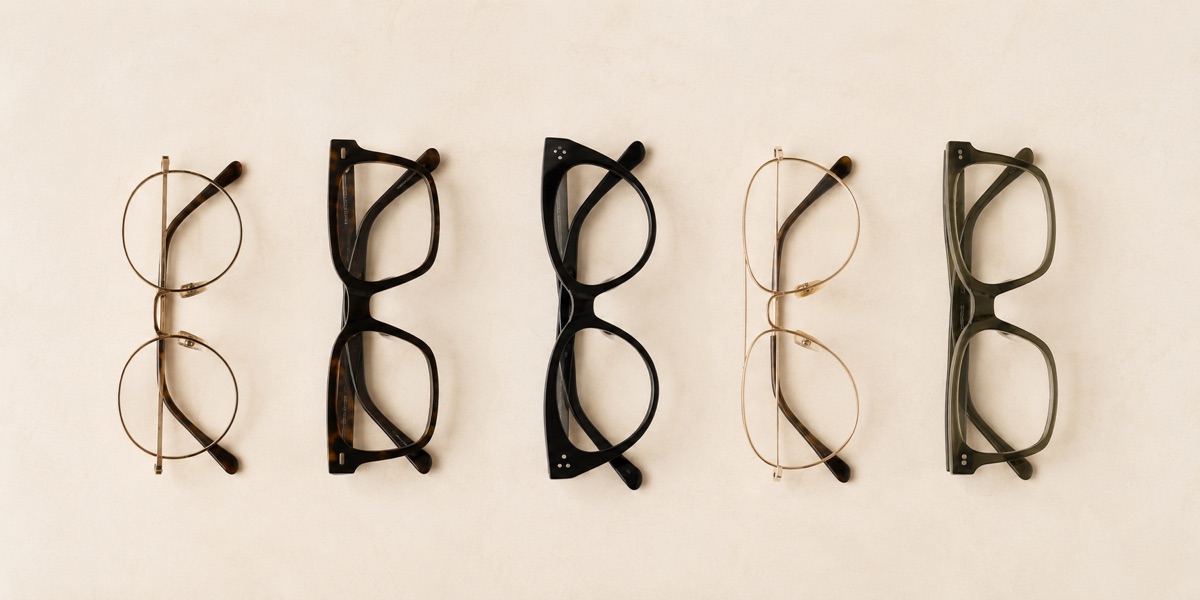
Choosing a pair of glasses is more than a vision correction decision — it’s one of the most visible style choices you make every day. The right frame can balance your facial proportions, highlight your best features, and project exactly the kind of confidence you want. The wrong one can do the opposite.
The good news: there’s a science to it.
Facial geometry research, used widely in ophthalmology and fashion, identifies five primary face shapes — and for each, there are frame styles that create natural visual balance. This guide breaks it down simply and practically.
Step 1 — Identify Your Face Shape
Stand in front of a mirror in good light. Pull your hair back. Look at the overall outline of your face and answer:
- Where is your face widest? Forehead, cheeks, or jaw?
- What is your jawline like? Sharp and angular, soft and rounded, or tapered?
- How long is your face? Does it look longer than it is wide, or roughly equal?
Use these answers to find your shape below.
The 5 Face Shapes and the Frames That Work Best
1. Oval Face
Characteristics: Slightly wider at the cheekbones, gently narrowing at forehead and jaw. Length is approximately 1.5x the width.
Oval faces are considered the most balanced proportionally, which means almost any frame style works. The goal is simply not to disrupt that balance.
Best frames: Walnut-shaped, rectangular, geometric, or square frames. Avoid frames that are too large — they can overwhelm the natural symmetry.
Avoid: Frames wider than the broadest part of your face.
2. Round Face
Characteristics: Width and length are nearly equal. Soft, curved lines with a rounded chin and full cheeks.
The goal with round faces is to add definition and create the visual illusion of length. Angular frames achieve this by introducing contrast against the softness of the face.
Best frames: Rectangular, square, or geometric frames. Narrow frames with sharp corners. High bridge styles that elongate the nose and face visually.
Avoid: Round or oval frames — they emphasise the roundness rather than balance it.
3. Square Face
Characteristics: Strong, angular jawline roughly equal in width to the forehead. Face is approximately as wide as it is long.
The goal is to soften the angles and add the perception of length. Rounded and oval frames provide a natural counterbalance to angular jaw lines.
Best frames: Round, oval, or curved frames. Thin frames with soft edges. Rimless or semi-rimless styles that reduce visual weight.
Avoid: Heavy square or rectangular frames — they double down on angularity rather than balance it.
4. Heart Face
Characteristics: Wider forehead tapering down to a narrow, pointed chin. Sometimes accompanied by a widow’s peak hairline.
The goal is to visually widen the lower half of the face to balance the broader forehead. Frames that draw attention downward or have more visual weight at the bottom work best.
Best frames: Bottom-heavy frames, rimless styles, oval frames, light-coloured frames. Low-set bridge styles.
Avoid: Cat-eye or heavily top-heavy frames — they add more visual weight to an already wide forehead.
5. Diamond Face
Characteristics: Narrow forehead and jawline with wide, prominent cheekbones. Often the rarest face shape.
The goal is to widen both the forehead and jawline visually to balance the prominent cheekbones.
Best frames: Oval or cat-eye frames that broaden the forehead. Rimless or frameless styles. Frames with detailing or distinctive brow lines.
Avoid: Narrow rectangular frames that emphasise the cheekbone width by contrast.
Beyond Shape — 3 More Things That Matter
Frame Width
Your frames should be roughly as wide as the widest part of your face — no wider, no narrower by more than a few millimetres. Frames that are too wide make your face look smaller; too narrow and they look pinched.
Bridge Fit
The bridge (the part that sits on your nose) affects how your glasses sit on your face. A bridge that is too high makes your eyes appear lower; too low and it makes the frame look like it’s sliding off. Always check that the optical centres of the lenses align with your pupils.
Colour and Contrast
Warm skin tones (olive, golden, brown) generally pair well with warm frame colours — tortoiseshell, brown, gold, olive. Cool skin tones (pink, blue undertones) work well with silver, black, blue, or rose frames. This is a guideline, not a rule — personal preference and confidence matter most.
The Most Reliable Method: Try Them On
All of the above is a framework, not a formula. Human faces are three-dimensional, and two people with the same “face shape” can look completely different in the same frame.
The most reliable way to find your best frame is to try multiple styles in person — with good lighting and a second opinion from someone whose eye you trust.
At Deshpande’s Optiview, our team has helped thousands of Nashik families find frames that feel right. We take time with every fitting, we don’t rush, and we’ll tell you honestly what works and what doesn’t. Walk into any of our four branches — no appointment needed.
References: Brooks CW, Borish IM. System for Ophthalmic Dispensing. Butterworth-Heinemann, 2007. | Adapted from clinical dispensing guidelines used in ophthalmic practice.